
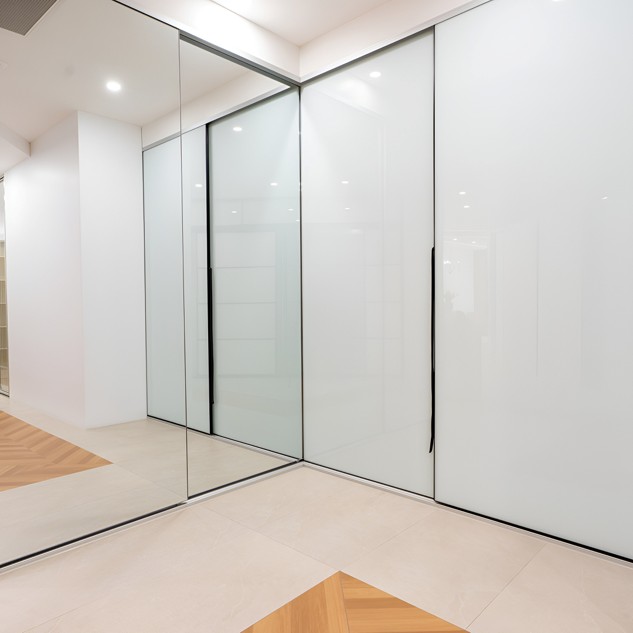
Sliding wardrobe doors solve the one problem hinged doors never quite manage, wasted floor space. At Modern Design Wardrobes, we design sliding wardrobe systems for Sydney bedrooms of every size, from compact apartments to generous master suites. Beyond saving space, the door material and internal layout make all the difference. Here’s what genuinely matters when planning one.
Table Of Contents
Key Takeaways
- Sliding doors save floor space hinged doors can’t recover.
- Mirrored doors visually enlarge smaller bedrooms.
- Interior configuration matters as much as the door style.
- Renters can often make minor storage changes without penalty.
- Track quality affects how well doors perform long term.
Why Sliding Doors Solve a Genuine Space Problem
A hinged wardrobe door needs clear floor space to swing open, space that’s often in short supply in a Sydney bedroom, particularly in older terrace houses and smaller apartment layouts. Sliding doors solve this by moving along a track rather than swinging outward, freeing up the floor entirely for a bed, a chair, or simply room to move. UNSW’s City Futures Research Centre has extensively researched how Sydney’s housing stock has shifted toward smaller, denser dwellings over recent decades, a trend that makes every centimetre of usable floor space count for more than it once did. For bedrooms with limited clearance, this can make space-saving and furniture placement easier while creating a more open, comfortable walkway around the wardrobe and sleeping area.
Mirrored, Timber, or Frosted: Choosing a Door Finish
Door material changes how a wardrobe performs in a room, not just how it looks. Mirrored doors do genuine double duty, offering a full length mirror while visually expanding a smaller bedroom by bouncing light back into the space. Timber veneer and two pack polyurethane finishes suit a more traditional or textured look, while frosted glass hides contents without the fully reflective effect of a mirror. Sliding Wardrobe range at Modern Design Wardrobes covers all three, built to match the rest of a room’s finishes rather than standing out as an afterthought. The right finish can also influence how bright, spacious, private, or visually balanced the bedroom feels, particularly when wardrobe doors occupy a large section of wall. Built-In Wardrobes are perfect for small bedrooms can also provide tailored storage that makes better use of limited wall space.
What’s Actually Inside Matters More Than the Doors
It’s easy to focus entirely on door finish and forget the interior does the actual work. A mix of hanging space, shelving, and drawers, proportioned to match what you actually own, makes a far bigger difference to daily usability than door material ever will. Research from UNSW’s Faculty of Arts, Design and Architecture tracing the history of Sydney apartment design notes that internal spatial layout has consistently mattered more to residents’ satisfaction than external presentation, a principle that applies just as directly to a wardrobe as it does to an entire apartment.
Renters and Flexible Living Arrangements
Sliding wardrobes suit renters particularly well, since a well built freestanding or semi fitted sliding system doesn’t always require permanent structural change to a room. NSW Government guidance on making changes to a rental property confirms that tenants can typically make certain minor changes without needing landlord approval, provided the change doesn’t affect the property’s structure. It’s worth checking your specific tenancy agreement, but sliding wardrobe systems are often a genuinely renter friendly option compared to permanent built-ins.
Track and Hardware Quality
Track and roller quality determines whether a sliding door glides smoothly for years or starts sticking and rattling within months of daily use. Cheaper tracks wear unevenly under repeated opening and closing, while quality hardware distributes weight properly across the roller system and stays quiet over time. This is one area where it’s genuinely worth paying for the better component, since replacing a worn track later, after doors and interior fittings are already installed, is far more disruptive than getting it right the first time. Look for hardware suited to the door’s weight and expected frequency of use, with accessible components that can be maintained or adjusted when required.
Sizing and Layout Considerations
Sliding wardrobe systems need a minimum wall width to accommodate the door panels and their overlap, so measuring accurately before committing to a design avoids awkward surprises. The collection of built-in wardrobe design examples shows just how differently sliding systems can be configured depending on room shape, from corner installations to full wall runs, proof that there’s rarely a one size fits all layout. Panel dimensions, available opening width, ceiling height, surrounding furniture, and access points should all be considered before final measurements are confirmed to avoid installation complications later.
Getting the Design Right
At Modern Design Wardrobes, we approach each project from measurement through to installation, and answers many of the practical questions that come up before committing to a design.
A few things worth considering before you choose:
- Does the room have enough wall width for the door panels?
- Would a mirrored finish genuinely suit the space?
- Is the interior layout matched to what you actually store?
- Are you renting, and if so, what changes are permitted?
- Is the track hardware rated for genuine daily use?
Conclusion
Sliding wardrobes offer a genuinely practical solution for bedrooms where floor space is at a premium, provided the door finish, interior layout, and hardware are all considered together. Getting these details right from the start means a wardrobe that performs well for years, not just on installation day. Ready to plan yours? Get in touch with our team at Modern Design Wardrobes and we’ll help bring your design to life.
FAQs:
Do sliding wardrobe doors save more space than hinged doors?
Yes, sliding doors don’t need floor clearance to open, making them ideal for smaller bedrooms.
Are mirrored sliding wardrobe doors a good choice for small rooms?
Yes, mirrored doors reflect light and visually expand a room, making them popular in compact bedrooms.
Can renters install sliding wardrobes without landlord approval?
Often yes for minor, non structural changes, though it’s best to confirm details in your tenancy agreement.
How wide does a wall need to be for sliding wardrobe doors?
This depends on door configuration, but panels typically need enough width to overlap fully when open.
What door finishes are available for sliding wardrobes?
Common finishes include mirror, timber veneer, two pack polyurethane, and frosted glass, depending on your style.
How often do sliding wardrobe tracks need maintenance?
Quality tracks need minimal maintenance, though occasional cleaning helps prevent dust build up affecting smooth operation.